
Privacy - X
Services: UX Research, UI Design, App Development

Project
Protecting your privacy online in the digital age seems like an impossible mission. Everywhere you look, it seems some company is either spying on their users or failing to protect their users' data. Our project therefore aimed to track digital footprints of the users and give options to edit permissions or delete their data from various platforms on a single click. This project was a part of our graduate course on Media History, we worked as a team of four.
Objectives
-
Using theoretical grounding and factual data, proposed a solution that should significantly influence humanity as critically as the information revolutions of the past have - either positively or negatively.
-
Final deliverable must offer a concise effective way of communicating the project idea, its functionality, and the market this concept will be piloted in.
My Role
As a UX Researcher my job was to manage and conduct user research and concept development. During the initial research phase, I did comparative analysis of online privacy for iOS versus Android over the period of time. I also synthesized qualitative data for functionalities and shortcomings of privacy apps and internet privacy in general.
During ideation phase I was responsible to research for the target market, created survey, did quantitative analysis of the data generated. At the evaluation phase, I was incharge of writing the research report.
Design Solution
Through our research, we learned data privacy and protection is a serious issue for Android users more than Apple users. As Tim Cook, Apple CEO, announced that you can download your data anytime--and delete it when you delete your Apple account that doesn’t mean Apple servers are not keeping your private information and there won't be glitches and hackers to invade your privacy, but it is nonetheless way more secure than what Android users are compromised on.
Therefore, our solution offered an app called Privacy X that allows users to easily track which sites are using their data, how much of it, and how they can control or modify these settings. Furthermore, with ‘Delete All Data’ feature users can actually delete all of the data associated with a particular account and app offers advanced functionality for users to manage their digital footprint.
Research
Target Users
Our target audience was individuals between the ages 20 and 45, as those seemed to be the ones most interested in securing personal data and ensuring their digital footprint was in their control.

Ideation
As a team we ideate on different features and functionalities we wanted to include in our app design. Unlike other apps, Privacy X doesn’t restrict itself to social media accounts or detail about email addresses, the app goes deeper and finds information about every ecommerce account, location tracking, call logs, search history, encrypted messaging and information collected through data brokers.

Target Market
Our market size is an estimated 4.54 Billion users worldwide. With capturing 0.01% of the market, this would transcend to 454,000 users. The beauty of our solution is the fact that it doesn’t have borders. We can serve clients in any country that has a digital footprint and sees the need of regulating what personal data is being circulated around the internet.
Insights
-
Large corporations like Google, Facebook, Instagram, Amazon have legal team worked on their privacy policies and they make it harder for user to understand how to opt out.
-
Information mishandling, snooping and location tracking are often the ways in which user’s privacy is violated online.
-
Many sites often store cookies and save your personal information and use it for various purposes.
How it works?

Design Opportunity
One Stop Solution: In-depth analysis of your digital footprint and data collected by third-party platforms.
360 Degree View: Fetch important information about privacy permission policies of each platform.
Data-informed Decision-making: Be aware of the information being shared online.
Legal Action: Option to file a legal action against the fraudulent practices by these websites.
Prototype
Low Fidelity Prototype
Based on our user research we sketched a mobile app wireframe using a paper template.

Medium Fidelity Prototype


End Result
After we made the changes based on our stakeholder’s feedback, we presented our final prototype.
All Information: Queries various data sources to find information about the user tied up to the unique identifier. We have used email address as our unique identifier.

Account Permissions: Reflects information linked with specific accounts and provides the option to individually delete accounts on these platforms.
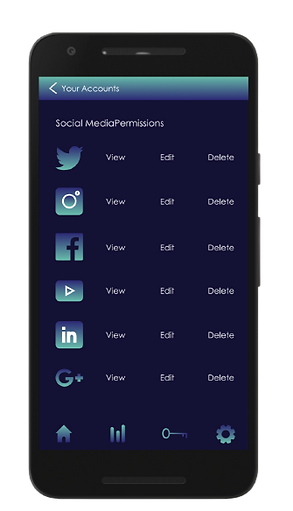
Data Control to Users: Provides visual summary of information across different platforms.
360 Surveillance: Our advanced search tool gets you information about all the third-party apps or software that has user’s information.


Final Prototype

Click View Prototype for the full Figma version.
Reflection & Takeaways
Data privacy is a complex subject to deal with, corporate world often wins privacy battles with individual users as their privacy policies are set by legal counsel who know how to protect their stakeholders. But when our team of UX Researchers and Designers started working to create this B2C app, we wanted to give best user experience to our customers without overwhelming them with information.
I learnt it is important to keep things simple as UX is the need for business nowadays. And since B2C apps are designed in response to user feedback and issues identified, they should align with goals, needs, and demands of the end users.
Since our project does not require us to do any usability testing but in future, I would prefer it otherwise. However, this study was a great learning opportunity for me to understand the value of data rights and privacy protection online.
Stakeholder
University of Waterloo
Year
2020
Methods
Comparative Analysis
Survey
Wireframes
Prototype
Tools
Figma
Whiteboard
Pen & Pencil